How EU’s EmpCo Directive Ends Greenwashing & Replaces Marketing Buzz with Third-Party Verification
2026.08.20


Vague slogans like "nature’s friend," "climate positive," and "eco-consciously made" are facing a regulatory reckoning.
The European Union’s Empowering Consumers Directive (EmpCo / Directive (EU) 2024/825) fundamentally alters how brands communicate sustainability. By amending the Unfair Commercial Practices Directive (UCPD) and Consumer Rights Directive, EmpCo officially bans generic, unsubstantiated green claims and sets strict compliance barriers for the Fast-Moving Consumer Goods (FMCG) sector.
For brands selling into the European single market, the grace period is closing. Understanding EmpCo's technical operational scope is essential for survival—as is deploying third-party verification frameworks to remain compliant.
What is EmpCo? The Core Mandates
EmpCo shifts green marketing from self-declared claims to verifiable scientific backing. Key provisions of Directive (EU) 2024/825 include:
- Ban on Generic Environmental Claims: Vague terminology—including "green," "eco-friendly," "environmentally sound," or "biodegradable"—is prohibited unless backed by recognized, top-tier environmental performance.
- Prohibition of Offsetting Neutrality Claims: Claims asserting a product has a "net-zero," "carbon neutral," or "climate-compensated" impact based on carbon offset schemes are banned. Only direct operational emissions reductions qualify.
- Strict Control over Sustainability Seals: Private or self-created ecolabels are prohibited. Displayed logos must originate from established public schemes or officially accredited, third-party certification frameworks.
- Accountability for Forward-Looking Commitments: Target statements like "100% recycled packaging by 2030" must be supported by a detailed, publicly available implementation plan independently verified by expert third parties.
The Implementation Roadmap
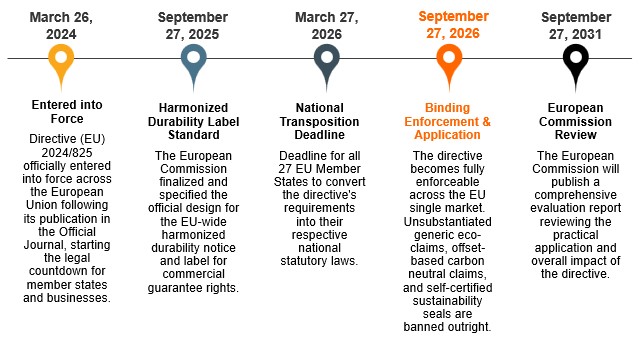
The Empowering Consumers Directive follows a strict timeline set by the European Union. Crucially, there is no transition or grace period for existing inventory—all packaging, digital marketing, and on-product environmental claims appearing on EU shelves must comply by the final application date.
Impact on Consumer Goods & Supply Chain Dynamics
EmpCo’s enforceability extends far beyond EU borders, directly impacting suppliers worldwide.
| Impacted Dimension | Regulatory Reality | Supply Chain Operational Change |
| Packaging & Labeling | On-pack claims must explicitly tie to a singular, scientifically verified attribute (e.g., specific recycled content percentages) | Total redesign of artwork, removal of vague iconography, and insertion of traceable QR codes |
| Material Sourcing | Material claims (e.g., "Biobased", "PFAS-Free") require batch-level data proving traceability | Upstream suppliers must provide ISO-aligned test reports and Chain of Custody documentation |
| Corporate Legal Risk | Non-compliance exposes firms to severe fines (up to 4% of annual turnover in relevant EU Member States) and costly class-action litigations | Cross-functional integration of Legal, R&D, Procurement, and Brand teams to vet every claim before public release |
European Green Deal vs. EmpCo Directive: Core Distinctions
While the European Green Deal sets the overarching macro-level climate agenda, EmpCo functions as its sharp, consumer-facing operational instrument. The broader European Green Deal acts as a comprehensive policy umbrella designed to transform the EU into a resource-efficient, climate-neutral economy by 2050 through systemic reforms across industry, energy, and supply chains.
EmpCo, by contrast, focuses specifically on the final point of sale by amending existing consumer protection laws (UCPD and CRD) to police marketing language, eliminate greenwashing, and ensure market actors align with the Green Deal's overarching ambitions.
| Dimension | European Green Deal | Empowering Consumers Directive (EmpCo) |
| Regulatory Nature | Broad overarching policy framework & legislative strategy | Target-specific, binding EU Directive ((EU) 2024/825) |
| Primary Objective | Transition the EU economy to net-zero emissions by 2050 | Eliminate greenwashing and protect consumers at the point of sale |
| Mechanism | Multi-sector mandates (Ecodesign, CSRD, CBAM, EU ETS) | Amends consumer protection laws (UCPD & CRD) |
| Scope of Enforcement | Macro-level industrial, energy, and corporate supply chain operations | B2C product claims, environmental labels, and advertising language |
Turning Regulatory Compliance into Market Advantage: SGS green marks
EmpCo strictly restricts unverified green marketing, creating opportunities for businesses with scientifically validated product attributes. Navigating this shift requires a robust testing, inspection, and certification partner.
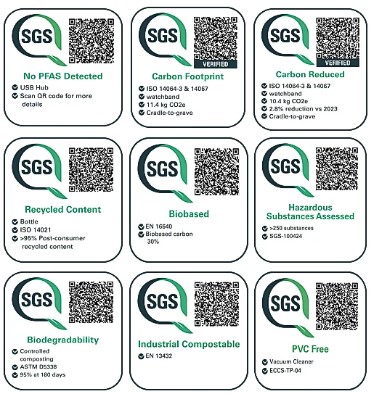
The SGS green marks scheme provides an accredited, single-attribute certification framework aligned with ISO 17065, ISO 17029, and ISO 14021 standards. By isolating and scientifically testing individual environmental qualities, the scheme directly complies with EmpCo's mandate for clear, single-feature substantiation.
How SGS green marks Secure Your Business Against EmpCo Risks
- Third-Party Credibility: SGS acts as an accredited independent party. The certification mark replaces questionable corporate self-declarations with verifiable third-party assurance.
- On-Pack Transparency & QR Traceability: Every SGS green mark issued features a scannable QR code linking consumers, regulatory officials, and retailers directly to a verified summary of the scientific testing protocol, maintaining full transparency.
- Mitigated Greenwashing Risk: By isolating single, precise product attributes rather than making broad claims, brands stay within the legal boundaries of EmpCo.
EmpCo signals the end of passive, unchecked environmental claims. Brands that replace vague marketing jargon with independent testing and verifiable marks will satisfy regulatory demands while building lasting consumer trust.
Please subscribe and contact us at TIC Mall for more details.


See More Blog