Why is 2026 the critical year to complete your SBTs before the SBTi 2027 update arrives?
2026.03.18


The Science Based Targets initiative (SBTi) is preparing to release its Corporate Net‑Zero Standard Version 2 (V2) in 2027—a major update that will influence how companies of all sizes set climate goals. 2026 is the most strategic window to complete or refresh Science‑Based Targets before the methodology changes.
Acting now does more than simply “meet requirements”. It strengthens market confidence, supports access to sustainable finance and enhances your position within increasingly climate‑driven global supply chains.
UNDERSTADING THE SBTi AND THE 1.5°C PATHWAY
The SBTi—co‑founded by CDP, the UN Global Compact, the World Resources Institute and WWF—provides the world’s most widely adopted framework for setting science-aligned emission reduction targets. Under the 1.5°C pathway, businesses must reduce emissions in line with IPCC carbon budgets across:
- Scope 1 (direct emissions) ;
- Scope 2 (energy‑related emissions) and
- Scope 3 (supply chain emissions)
Organizations must set near‑term targets (typically 5–10 years) to drive rapid decarbonization, and long‑term net‑zero targets requiring at least 90% absolute emissions reductions before neutralizing the residual.
This framework not only accelerates climate action—it reinforces credibility through transparency, annual progress reporting and independent third-party assurance services.
INCREASING GLOBAL AND REGIONAL ADOPTION
Momentum continues to grow. By mid‑2025, nearly 11,000 companies worldwide had set or committed to SBTs, representing about 41% of global market capitalization. Asia recorded 134% growth from 2023 to 2025, and Hong Kong alone reached 113 organizations with validated or committed targets by end‑2025 - an 87.8% increase in just one year.
This rapid adoption signals a critical shift: SBTs are becoming a mainstream expectation, not a niche practice, for both corporates and suppliers.
WHO SHOULD PRIORITIZE SBTs?
For multinational and listed companies, SBTs help align with global climate reporting standards such as ESRS and CDP.
For SMEs and suppliers, SBTs demonstrate readiness to meet customer expectations - especially as large buyers use emissions data and science-based targets to guide procurement decisions.
FOUR STRONGEST REASONS TO COMPLETE SBTs IN 2026
1. Take advantage of the pre‑2027 methodology window
With the new SBTi Net‑Zero Standard V2 coming in 2027, organizations that act in 2026 can still adopt or refresh targets under the current methodology.
This helps organizations:
- avoid potential tightening, stricter thresholds, or higher data requirements,
- reduce conversion or realignment costs later, and
- avoid resource-intensive rework.
Early movers position themselves with predictable requirements—an attractive signal to investors, regulators, and procurement partners.
2. Build a strong governance and data foundation early
SBTs require a five-year review cycle, meaning governance structures, data controls and internal roles must be clearly defined. Starting this work in 2026 lays a solid foundation before the new standard arrives.
This also helps organizations:
- streamline future reviews,
- strengthen internal audit and risk management,
- improve data integrity for HKEX and CDP reporting.
Organizations that begin early gain operational discipline that compounds over time.
3. Prepare for rising Scope 3 expectations from buyers and regulators
Scope 3 is increasingly the “make or break” factor for supply chains. Buyer programs, especially in emissions‑intensive sectors, focus heavily on supplier alignment with science‑based targets.
CDP 2025 - aligned with ESRS - will further enhance cross‑supplier comparability.
This means:
- suppliers without SBTs risk being deprioritized,
- emissions transparency will influence tendering, prequalification and long-term contracts,
- large buyers will expect clear reduction pathways, not only carbon footprints.
Completing SBTs in 2026 ensures suppliers are not caught unprepared when disclosure pressure peaks.
4. SMEs are now directly targeted by SBT campaigns
SBT adoption is no longer limited to listed companies. CDP’s annual SBT campaign - supported by banks, investors and multinational buyers - specifically targets SMEs, asking them to set targets and report annual emissions data.
This creates a cascading effect across entire supply chains.
Even non‑listed, private, or export‑oriented companies must now demonstrate credible climate action to remain competitive.
Setting targets in 2026 positions SMEs as proactive rather than reactive.
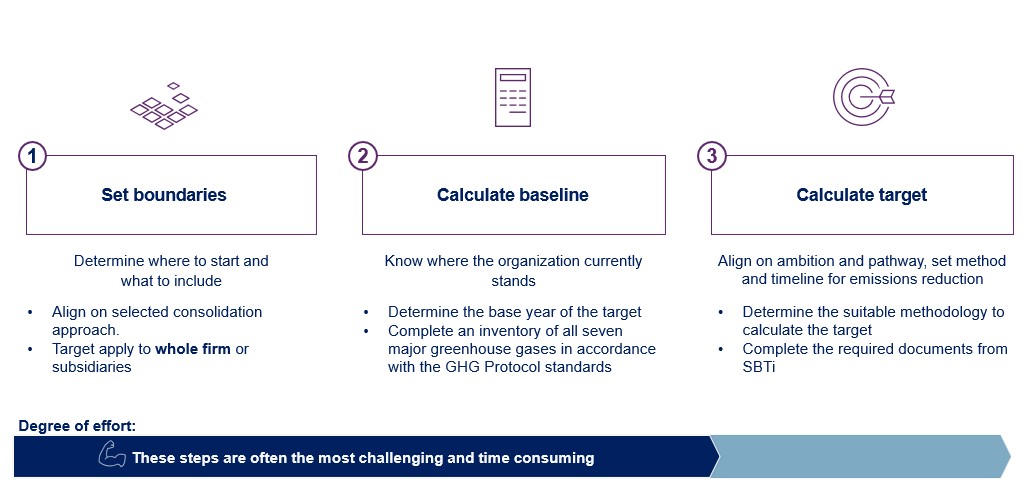
SGS THREE-STEP SBT APPROACH
To support organizations through this journey, we offer a structured, end‑to‑end approach:
Step 1 — boundary and materiality
Define Scope 1–3 boundaries, identify emissions-intensive activities, assess supplier influence, and clarify internal roles for data management and decision-making.
Step 2 — baseline and data governance
Establish a base-year inventory following the GHG Protocol, define data quality standards, evidence retention, and independent assurance requirements aligned with HKEX and CDP.
Step 3 — target setting and transition planning
Develop near‑term and net‑zero targets, implement actions such as energy improvement, process optimization and supplier engagement, and define annual milestones to track progress.
WHY SGS AS YOUR UNIQUE PARTNER?
Choose us as your SBT partner because organisations today need more than consulting - they need credibility, reliable data and a scalable digital foundation to deliver real climate progress.
We offer:
- Independent global assurance credibility trusted by regulators, banks and multinational buyers
- End‑to‑end SBT support, from baselining to submission to annual progress verification
- Regional expertise across HKEX, CDP and global supply‑chain expectations
- S‑Carbon digital platform advantage — our comprehensive digital carbon platform streamlines carbon data, strengthens governance and delivers consistent, SBT‑ready inventories
- Implementation‑focused guidance that turns targets into practical, measurable decarbonisation actions
- Audit‑ready documentation from day one, reducing future reporting and verification costs
With SGS, your SBT journey becomes faster, more accurate and fully assurance‑ready.
HOW TO SET A TARGET
SGS key service scope